

Incurable wounds, a lot of deaths, scary-looking doctors in masks, chaos and panic haunted Londoners for several centuries in a row. We are talking about plague epidemics in the city. The disease spread very quickly and destroyed almost half of the population each time. Sometimes a large-scale epidemic spread among the military and negatively affected some historical events. As soon as Londoners forgot about those horrors, the disease returned again after several decades, reminding them of its existence. Although history tells us of several large-scale epidemics, experts say that the plague reigned in London every 20-30 years. How did it affect human evolution and why are its consequences still evident in the modern world? Learn more at ilondon.info.
Prerequisites of the terrible disease and its spread
The main reason for the appearance and spread of the plague in London was the terrible daily life conditions. There was no proper sewage system, pavements were covered in litter, the street smelled awful and a lot of people gathered in houses that rarely got aired. Residents of London didn’t even know about the basic rules of hygiene. Such simple actions as washing hands and airing the rooms were not included in the normal daily routine. Most of the population lived quite poor and usually thought only about how to feed the family. They didn’t worry too much about their health or improving their living conditions. Medicine was not yet developed properly and doctors could only offer some general advice and medicines. During large-scale epidemics, they didn’t have time to visit each patient. Under such conditions, the plague was quickly spread by rats and fleas, which at that time, were ordinary residents of the households.

However, usually, London wasn’t the epicentre of the disease. Pathogens entered the city because of sailors. A large number of fleas were frequently found in cargo brought from other parts of the world, which most likely caused plague outbreaks. Moreover, the residents of the city didn’t treat the disease seriously enough. When it disappeared they thought that it was the end of their suffering and didn’t try to take any measures to avoid future outbreaks. A vivid example is the Black Death of 1348, after which people hoped for the best, but ten years later it returned again.
Plague epidemics in London in the second half of the 16th century
It is believed that the first large-scale wave of the epidemic began in China in the 1300s. It spread quite quickly around the world, thus, plague outbreaks were observed in remote corners of the globe. The causative agents of the disease even reached Australia, Norway and Finland. True chaos reigned in London and many European cities. The number of victims taken by the plague was extremely high at that time. However, the most terrible thing was that the disease returned from time to time and each time enveloped entire cities and villages in darkness. In the second half of the 16th century, London also faced several plague epidemics and lost a lot of residents.

In 1563, the death toll in London and its outskirts was approximately 20,000 people. The population of the city decreased by 25%. The authorities tried to take measures. For example, people were urged not to come to the church service if they had contact with the sick. Also, they ordered the killing of all street dogs and cats to prevent the spread of the epidemic. People should paint crosses on the home doors of the infected. Unfortunately, such measures weren’t effective enough. The first cases of infection were recorded in June of that year, and by August, about 1,000 people were dying every week. A large number of people left the city, including members of the royal family. However, it resulted in the spread of the disease outside the city. Many people tried to take their animals out of the city at the beginning of the epidemic, which caused the plague to spread to the surrounding villages. At the height of the disease, everyone who remained in the city tried not to leave their homes. The once loud and bustling London has turned into a quiet extinct place where meeting a person seemed like the strangest thing in the world. It also significantly affected the economy because trade was almost completely halted and people were becoming poorer and poorer. The death rate began to decrease with the arrival of cold weather. Fleas and rats, which were the main spreaders of the infection, disappeared in winter, so the plague left London at the end of January.
The Great Plague of London (1665-1666)
Another large-scale epidemic that entered history is the Great Plague of London. It is considered the last epidemic of bubonic plague in England. The disease got that name because of the blisters that appear on the infected body and was also distinguished by its spread scale and fatality. The problem of unsanitary conditions has remained relevant and unchanged since the epidemic outbreak of 1348. Streams of filth flowed down the streets of London, its cobblestones were covered with animal dung and other garbage with flies circling over it. Thus, the conditions were extremely favourable and probably the best possible ones for the development of various infections. The plague appeared in the city in 1665. However, at first, nobody considered it an epidemic because it had already become a common phenomenon and an ordinary disease at that time. Newspapers published the number of its victims every year. Another problem was that many cases were silenced, and as a result, distorted statistics. Relatives of the dead didn’t want to reveal the true cause of death, and doctors, in turn, documented another diagnosis.
In 1665, the government began to take the first measures to prevent the epidemic from spreading. They established home quarantine and also planned to use methods that were successful hundreds of years ago. When one of the family members fell ill, the whole house was closed for quarantine. Although it was quite effective, in fact, the whole family was doomed to die. Many residents didn’t like that method, so the authorities faced protests and built special facilities for the sick. They were located in distance from other people’s dwellings. The disease reached its height in summer. Everyone, who could, left London. Charles II and his family also left the city, but many people remained because they had no money. The royal family returned in February 1666, when the number of deaths began to decrease significantly. The plague finally left the city after the Great Fire of London. After a series of such events, the government decided to widen the streets of London, stop the use of open sewers and ban wooden buildings.
Archaeological finds enabled scientists to research the disease in detail

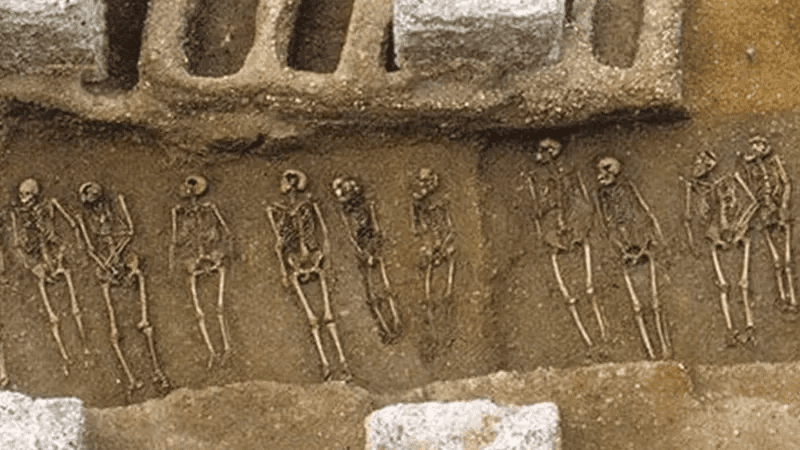
Modern specialists and researchers have got the opportunity to learn more about the epidemic features and study the disease owing to the excavation of mass graves. Londoners created them for burial during large-scale epidemics. Its skeletons are usually found during the construction process. For example, such mass burials were found when, in 2012, it was decided to build a new entertainment centre. Between 2011 and 2015, workers laying the railway track found 3,500 burials too. Thanks to scientific research, it was possible to determine that the disease affected the health and evolution of modern people. Although such a gene that affects our immune system helps to fight the plague, it carries the risk of developing Crohn’s disease and rheumatoid arthritis.