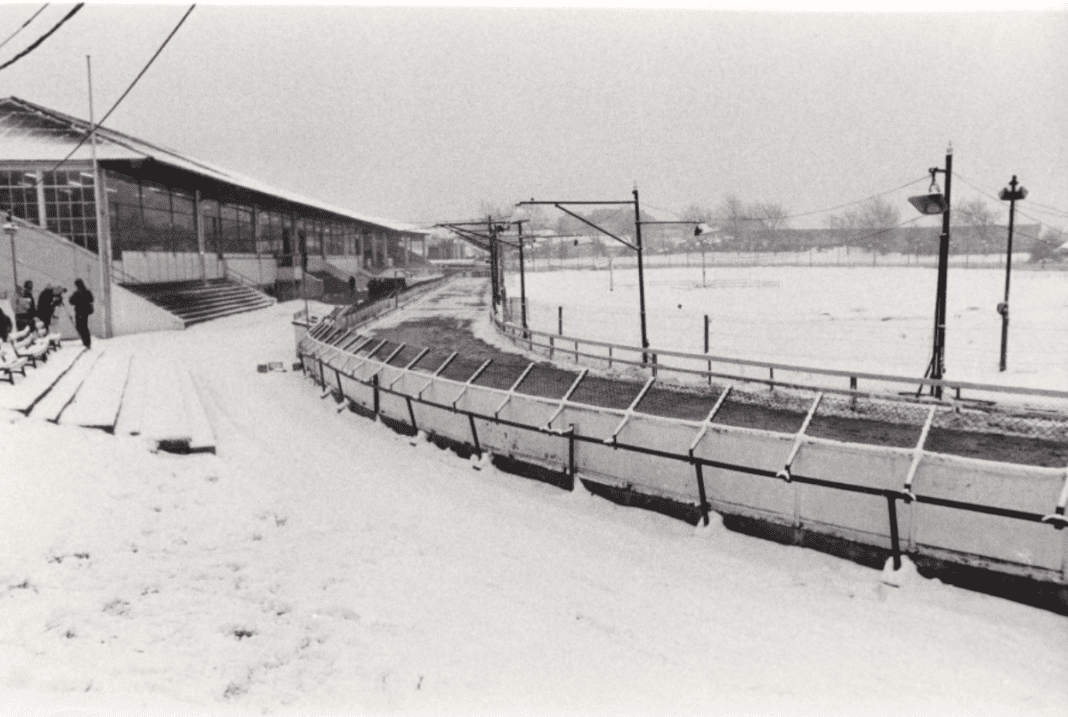

In the early 20th century, dog racing enjoyed immense popularity in Great Britain. This was especially true among the working class, who found it an accessible alternative to horse racing. In this context, Hackney Wick Stadium became a key centre for greyhound racing, transforming it into one of the country’s most beloved sports. Read more at ilondon.
History of the Founding and Development of Hackney Wick Stadium
Hackney Wick Stadium opened on 8 April 1932, under the auspices of the British Greyhound Association. The project was initiated and managed by Hackney Wick Stadium Ltd, led by director Arthur Gilbert and racing manager Fred Whitehead. With a capacity of between 30,000 and 50,000 spectators, the arena immediately became a focal point for racing enthusiasts. A totalisator was installed on the very first evening, and the event was attended by 13,000 people. The official opening was performed by Marjorie Graves, the Member of Parliament for South Hackney.
After World War II, the Hackney Wick and Hendon Greyhound Stadiums merged into a single company, Hackney and Hendon Greyhounds Ltd. The combined kennels featured six runs, each capable of housing up to fifty greyhounds. Adjacent to these were compounds with a kitchen and a veterinary surgeon, ensuring comfortable conditions for the animals.
In 1963, speedway racing was introduced at the stadium in the form of the Hackney Hawks team. This coincided with the stadium’s reconstruction, which included the opening of a restaurant and general infrastructure improvements. Despite the modernisation, the number of races decreased: instead of the six pre-war meetings per week, they were held only on Thursdays and Saturdays at 7:45 pm. The competition track was 472 yards long, with the greyhounds chasing an Outside Sumner mechanical hare.
In 1970, businessman George Walker orchestrated a reverse takeover of Hackney and Hendon Greyhounds Stadium Ltd. His private company bought the public company, leading to the formation of a new enterprise called Brent Walker. Consequently, the Hendon Greyhound Stadium declined and was sold off to make way for the Brent Cross shopping centre, the first stand-alone mall in Great Britain.
When Hendon Greyhound Stadium closed, important competitions began to take place at Hackney Wick. In 1969, the Guineas Race moved here from Park Royal. In 1976, a local greyhound named Westmead Champion, trained by Pam Heasman, distinguished himself by winning the Golden Collar, the St Leger, and the Regency. Along with Mutt’s Silver, he earned the title of Greyhound of the Year.
In 1994, the bankrupt George Walker sold Hackney Wick Stadium to London Stadium Hackney Ltd, which belonged to Fleetfoot Racing, headed by Robert Parker. Stephen Rea soon replaced Parker in the management role. Due to financial difficulties and construction problems, the cost of the new project ballooned to £14 million. In 1995, the renovated London Stadium opened with improved facilities and larger prizes. However, that very night, it was declared bankrupt. Fleetfoot Racing Ltd only survived for three years, and the arena finally closed on 4 January 1997.
The London Stadium remained derelict until 2003, when the London Development Agency purchased and demolished it. The London Olympic Media Centre was built in its place, which subsequently served as the main broadcasting hub for the 2012 Summer Olympics and the 2012 Summer Paralympics.
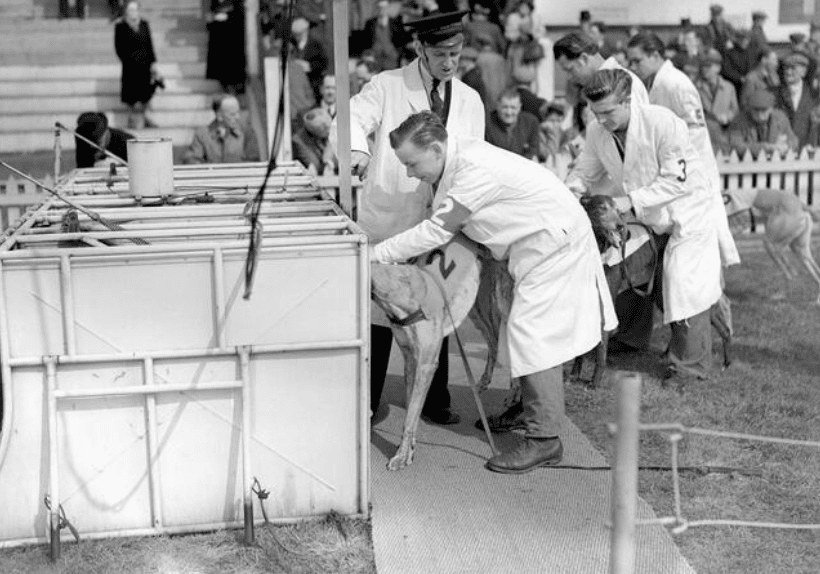 Alamy
Alamy
Recognition and Significance of Hackney Wick Stadium
Hackney Wick Stadium was a significant sporting venue in Great Britain. It served not only as a place for competition but also as a hub for culture and leisure for thousands of people. The arena was home to legendary greyhounds such as Ballyregan Bob, Sound Wave, Dublin Daisy, Tully-Ho Sabrina, and Don Gypsy. They were trained by notable figures including Annetts, Reg Bosley, Brown, Colebrooke, Cox, Paddy Gordon, Headley, and Lionel Maxen. Furthermore, the speedway teams competed under various names, including the Hackney Wick Wolves, Hackney Hawks, Hackney Kestrels, and London Lions.
Keith Collman