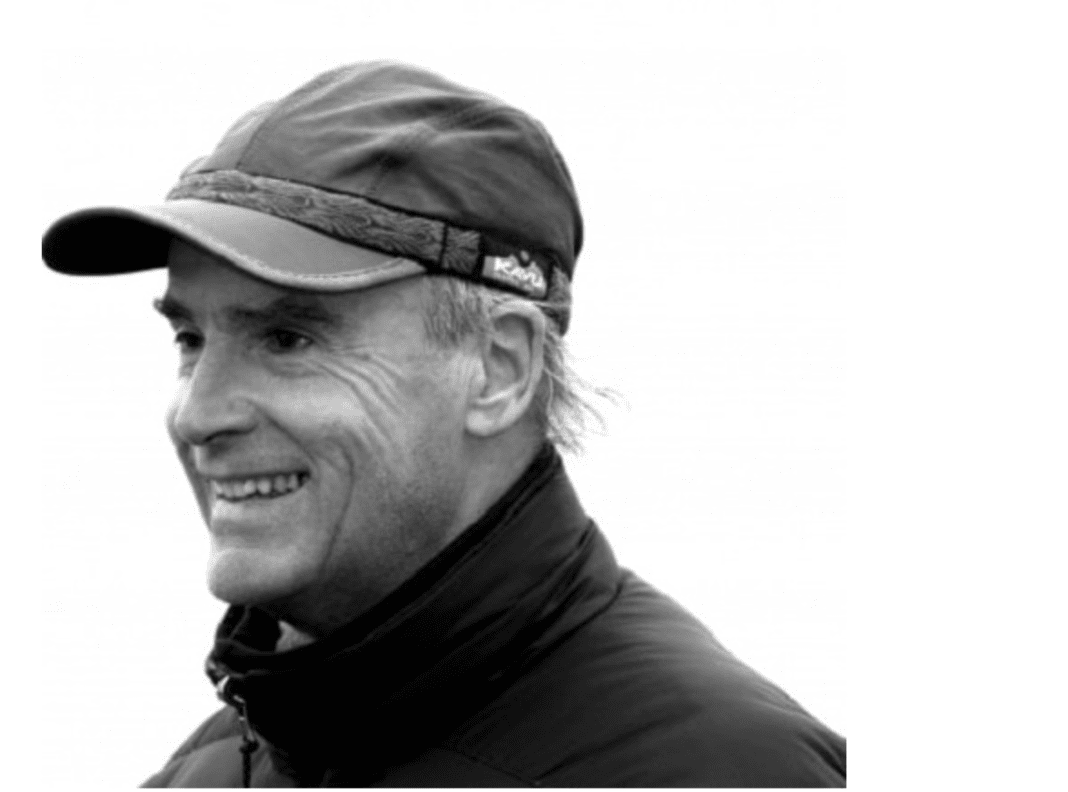

Hamish Fulton successfully forged a new conceptual approach to human interaction with nature. By reimagining the art of walking, he transformed long-distance treks into a form of artistic practice. Read more at ilondon.
Artsy
Hamish Fulton’s Early Years and Creative Journey
Hamish Fulton was born on 21 July 1946, in London. His artistic path began within the walls of the prestigious Hammersmith College of Art in 1964. There, the young man gained not only knowledge but also the support of his mentor, the artist David Hall. With Hall’s encouragement, he became an advanced student at St Martin’s School of Art in 1966.
While studying, Hamish Fulton initiated his unique artistic practice of walking. In 1967, he completed a journey from the educational institution to the countryside. This wasn’t merely a hike; it was the first step in forming the young artist’s signature method. In 1969, he enrolled at the Royal College of Art, where he fully developed the defining characteristics of his work.
Following this, Hamish Fulton travelled across South Dakota and Montana. It was then he realised that creativity wasn’t limited to the traditional creation of physical objects. It could be a way of seeing the world, experiencing it, and living within it. “A walk has its own life and does not need to be materialised into a work of art. A work of art can be bought, but a walk cannot be sold,” the artist stated. In 1969, he invited visitors to the Konrad Fischer Gallery to witness this for themselves during his first solo exhibition.
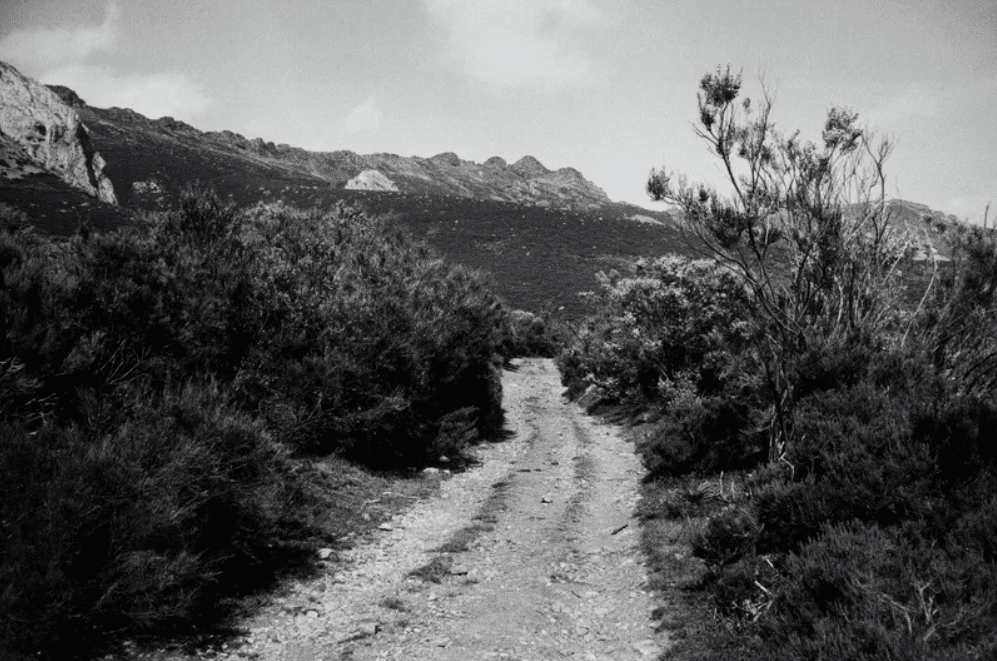
In 1973, Hamish Fulton walked over 1,500 kilometres from Duncansby Head to Land’s End in 47 days. During the journey, he meticulously documented the route, natural obstacles, and the total duration of the walk. Thus, the artist’s photographs went beyond traditional landscape photography; they were supplemented with information that provided the viewer with additional context. For instance, captions would detail the location, time, climatic conditions, or out-of-frame specifics. By 1977, he had presented his work in Great Britain, the Netherlands, France, Germany, and Italy.
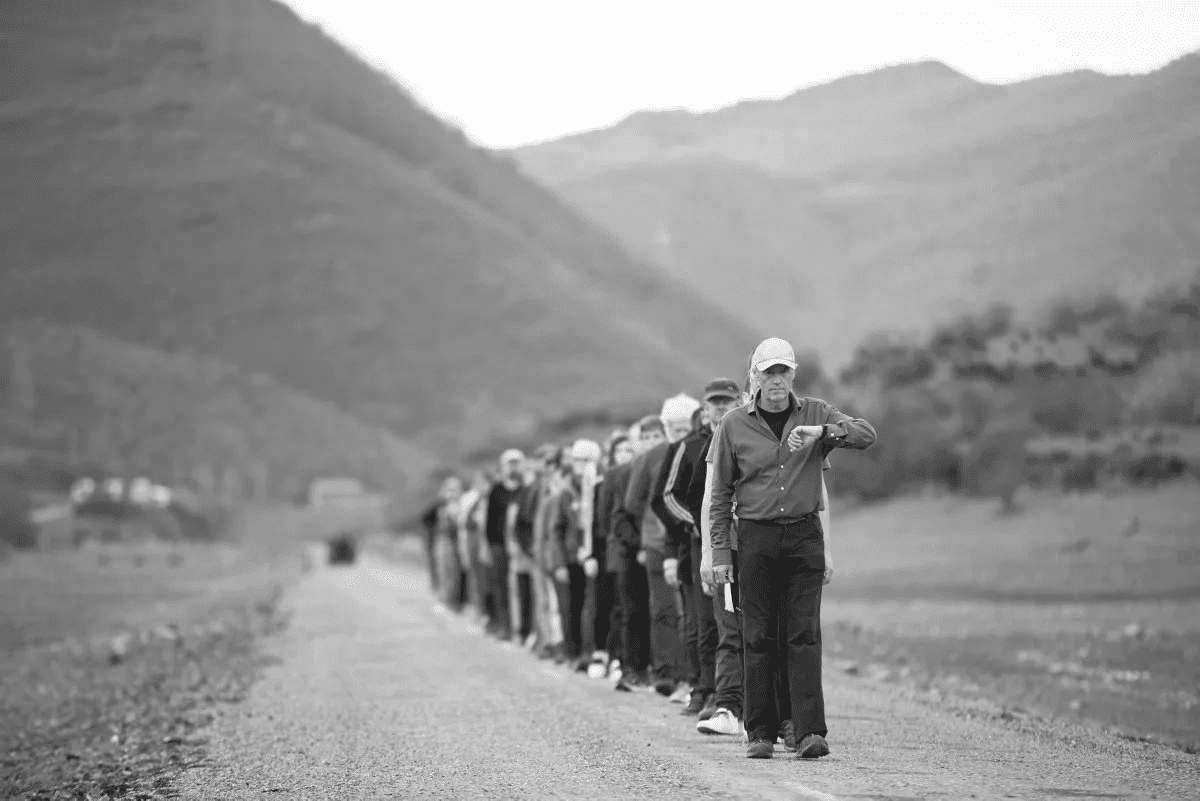
Expanding his artistic practice, Hamish Fulton began experimenting with group walks in the 1990s. During a collaboration with Marina Abramović at the Kitakyushu Center for Contemporary Art, he organised a series of collective routes. In 2002, the artist arranged a series of group walks in France with the artist Christine Kuor. He adopted her style of walking uniformly at an equal distance from one another, which encouraged a deeper experience of the space and interaction among participants.
Commissioned by the arts organisation Deveron Projects, Hamish Fulton began the “21 Days in the Cairngorms” project in 2010. Encompassing two group walks in Huntly, the project allowed him to continue his work in the mountains. The artist subsequently published the book Mountain Time, Human Time, in which he shared his experience of being in the Cairngorms, seeking to reveal the complex relationship between art, nature, and time.
L’Humanité
Recognition and Significance of Hamish Fulton’s Artistic Work
Hamish Fulton played a crucial role in the development of Land Art. Over his lifetime, he walked nearly 20,000 kilometres during journeys across 25 countries, including the USA, Canada, Mexico, Peru, Nepal, Argentina, Chile, India, Australia, Japan, and Tibet. His works are held in over 30 public collections around the world, including the Victoria and Albert Museum, the National Gallery of Scotland, the National Gallery of Iceland, the National Gallery of Australia, and the Tokyo Art Museum. The artist also documented his walks in publications such as Walking in Relation to Everything, Magpie: Two River Walks, and Wild Life: a Walk in the Cairngorms.
Whitehot Magazine