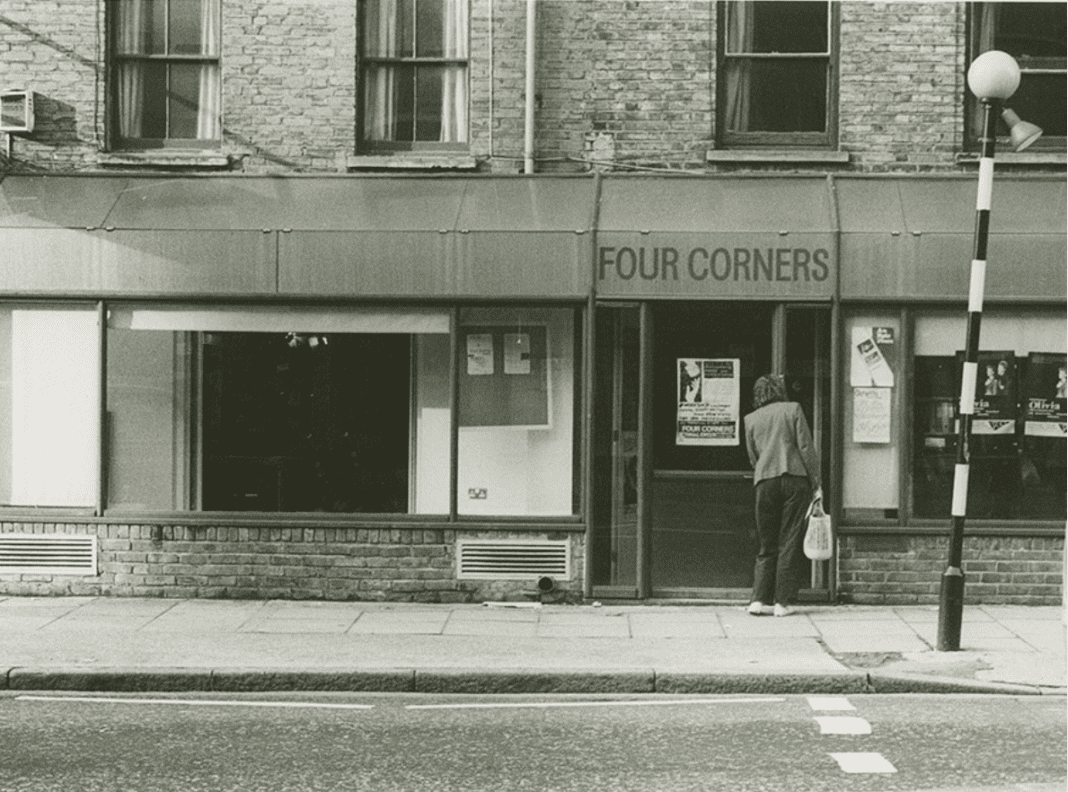

In the 1970s, the high cost of equipment made filmmaking inaccessible to many residents of London. Consequently, producing films was possible only for the elite and established professionals. The Four Corners arts centre played a crucial role in democratising the British screen. Operating in an environment of limited media access, it managed to challenge the prevailing media establishment. Read more at ilondon.
History of the Founding and Development of Four Corners
The Four Corners arts centre was founded in 1973 when young filmmakers Joanna Davis, Mary Pat Leece, Ronald Peck, and Wilfrid Wylam Tust came together. Their goal was to expand the boundaries of independent cinema—in production, exhibition, and accessibility. The team ultimately created a multi-purpose space with a cinema and production workshop at 113 Roman Road in Bethnal Green, London.
Four Corners quickly transformed into a platform for developing an inclusive screen in Great Britain. In 1979, Ronald Peck and Paul Hallam shot the first British feature film about homosexual relationships. Simultaneously, in 1986, Ruhul Amin became the first director to represent the Bangladeshi diaspora on the national screen. In this way, the work of the multi-functional centre gave a voice to the underrepresented tapestry of ethnic groups, religions, and subcultures of the time.
In the 1980s, Four Corners financed its projects through a temporary franchise as part of the Channel Four Workshop Agreement programme. However, after the collaboration ended, it was forced to shift the focus of its activities. As a result, the multi-purpose space concentrated on supporting artists, including BAFTA and Turner Prize nominees. Furthermore, it began offering training programmes for interns and local filmmakers.
In the 1990s, Four Corners boosted its authority thanks to its free professional development programme. It opened new prospects for unemployed individuals with unconventional career paths. Thus, the inclusive approach once again provided people from diverse backgrounds and experiences with professional opportunities in the art world.
Soon after, the Four Corners and Camerawork organisations merged to preserve their independence. In 2003, the former took over the latter’s old premises at 119–121 Roman Road. Here, the plan was to open new photographic darkrooms and a photo gallery. In 2007, the team finally completed the £1 million project. The modern, flexible space now encompasses a gallery, educational classrooms, screening rooms, photo labs, and studios. It offers a wide range of services for creative individuals, including organising exhibitions, providing co-working spaces, and ensuring access to professional equipment.
Over the following years, Four Corners organised a number of important cultural events focusing on pressing social and political issues. In 2019, one such event was a photography exhibition by Nora Smith, where she explored the legacy of the East End suffragette movement through historical tours and panel discussions. In 2022, the team launched the project “Brick Lane 1978: The Turning Point”. Its central theme was the reaction of the Bengali community to the tragic death of Altab Ali—the victim of a racist attack that rocked the entire country.
Roman Road LDN
Recognition and Significance of Four Corners’ Work
The Four Corners arts centre continues to bring together filmmakers, photographers, artists, interns, and local residents from across the country. It serves approximately 500 individuals annually through its specialised programmes, which provide access to professional equipment, technical knowledge, and opportunities for creative skill development. It is supported by organisations such as Arts Council England, the London Development Agency, Film London, and the European Regional Development Fund.

Roman Road LDN