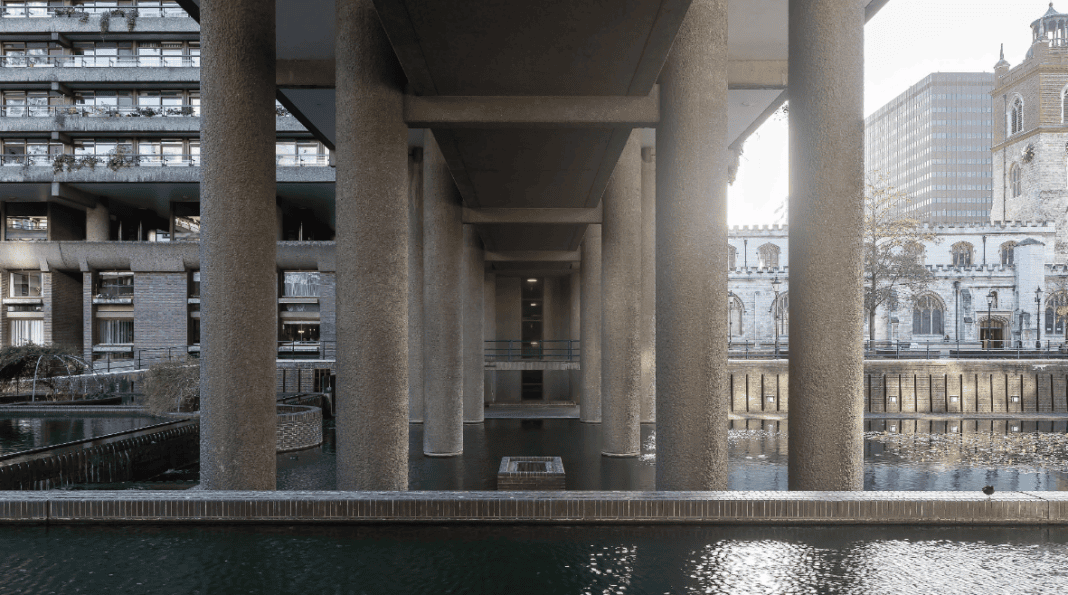

London’s residential landscape has been shaped by many factors over the years. Its growth has been closely tied to historical events, social movements, Jewish culture, and diverse religions. Certain social shifts also paved the way for the concrete blocks of the Barbican Estate. Although these imposing buildings have frequently landed on lists of the UK’s worst architectural designs, they boast a unique history, rich symbolism, and deep connections to creative communities. What sets this complex apart, and what secrets lie behind its concrete walls? Read on at ilondon.
A New Vision, a New World, a New Culture of Living
The construction of the Barbican Estate stands as a powerful symbol of London’s post-WWII rebirth. The area had been almost completely flattened by wartime bombing. In 1965, a monumental construction project began that would span over a decade. The redevelopment was envisioned not merely as a restoration of pre-war housing, but as an opportunity to realize pioneering urban planning ideas focused on functionality, social equality, and a high quality of life. It also sought to provide modern housing for the middle and upper-middle classes, eliminating the need for daily commutes from the suburbs.
Architectural Features and the Principles of Brutalism
The architectural features of the Barbican Estate clearly reflect all of these underlying motives. First, the emergence of Brutalism as a style expressed post-war optimism and represented progressive politics capable of dismantling old social hierarchies. Second, the massive structures were associated with strength and enduring public prosperity. The result was a minimalist architectural design where structural elements take precedence over decorative ornament.
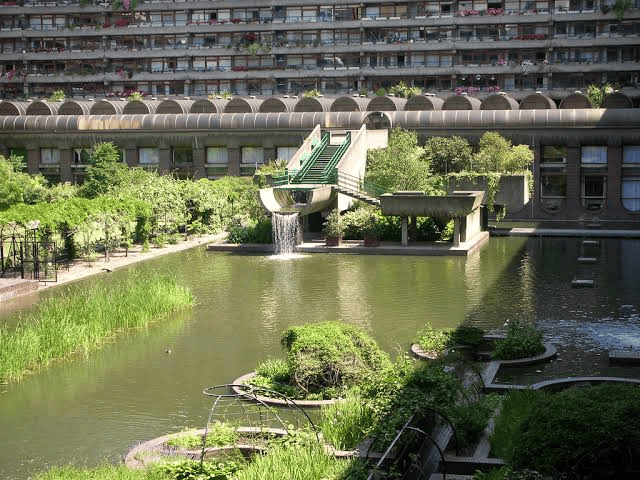
The entire complex was designed by the British architectural firm Chamberlin, Powell and Bon. Their task was no easy feat: the estate forms a complex pedestrian labyrinth created around the core principle of a car-free environment. The architects successfully segregated private, public, and communal spaces. Despite the dominant concrete framework, the complex features striking water features and tranquil inner gardens that give residents welcoming spots to enjoy their leisure time. Brutalism reveals itself directly through the raw concrete walls and hand-chiseled cast surfaces.
However, this raw austerity characterized not only the finished structures, but also the construction process itself. Working conditions on site were notoriously grueling, largely due to the demanding nature of working with concrete. To achieve the desired finish, the concrete had to cure for 21 days before workers could pick away the surface by hand using pickaxes to expose the coarse granite aggregate. Unsurprisingly, the construction was plagued by several accidents: workers fell from heights, and constant vibrations from hammers impaired blood circulation in their hands, leading to long-term health issues. Thus, the Brutalist architecture of the Barbican stands as a physical reflection of the sheer intensity of human labor.
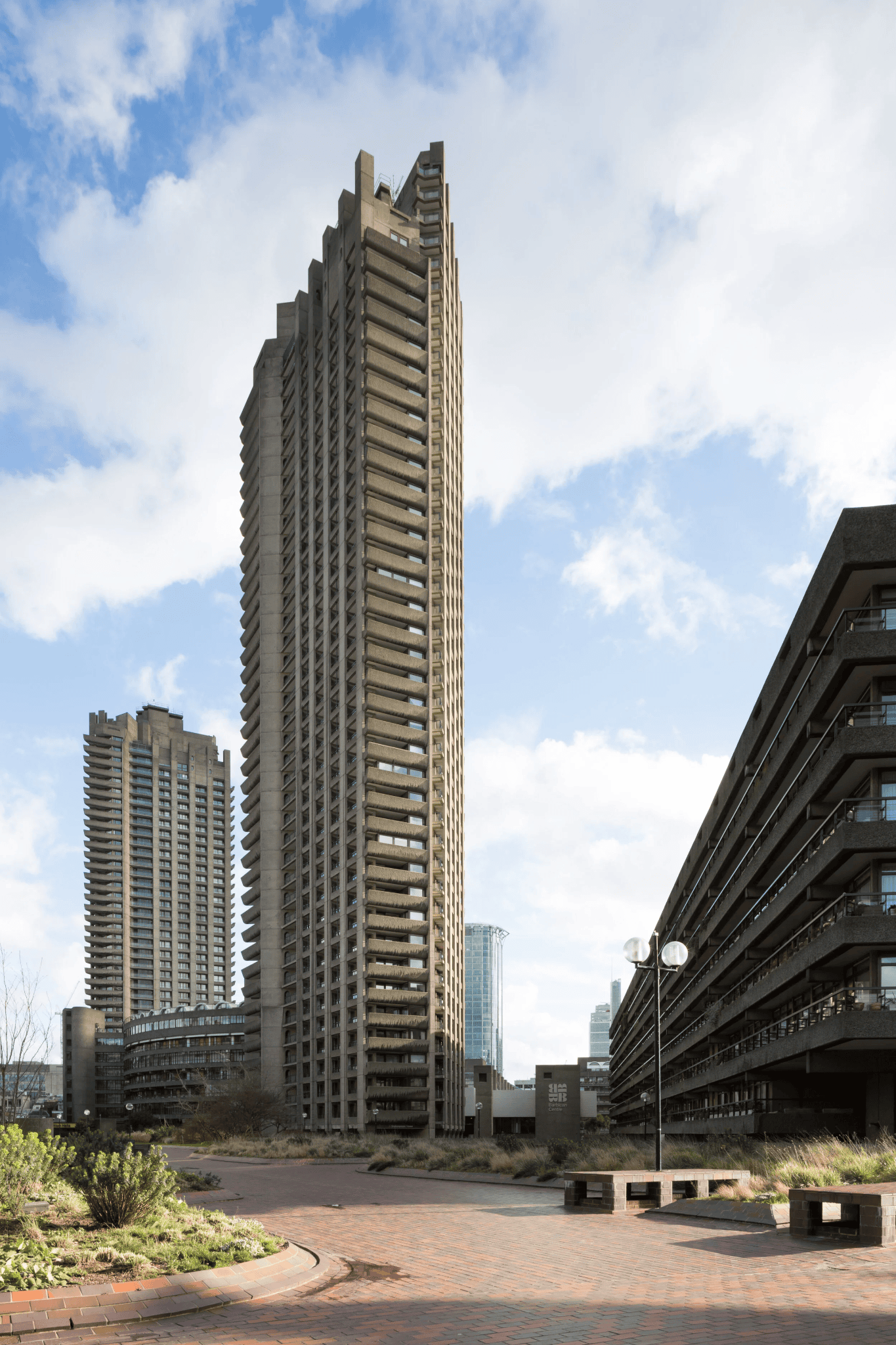
In total, the Barbican Estate comprises 14 terrace blocks and 4 towers. The site is also home to the Museum of London, the City of London School for Girls, the Guildhall School of Music and Drama, the Barbican Public Library, and the Barbican Centre. Additionally, from the balconies of certain apartments, residents can glimpse surviving fragments of the famous Roman London Wall. Ultimately, the site offers a deep dive into history and the mindset of its residents, while its grand scale and ambitious vision make the Barbican unlike any other housing project—a true testament to long-term architectural foresight.