

London is a city celebrated for its stunning vistas, captivating history, and impressive sporting achievements. Among the most popular sports in the metropolis is gymnastics, a discipline that beautifully merges strength, flexibility, coordination, and aesthetics.
This sport boasts a long and active history in London, continuing to thrive today. It’s not just about modern clubs inspiring children; it’s a narrative woven with Olympic dreams and major triumphs. Over the years, gymnastics has transformed from a humble amateur pastime into a significant professional pursuit. More on this story at ilondon.info.
Historical Roots
The story of London gymnastics kicks off in the 19th century, when the German, Karl Völker, opened an outdoor gymnastics school near Regent’s Park. It was a modest training ground where people learned to climb ropes and vault over bars. Although the school closed after 1830, it paved the way for the later “Primrose Hill” Gymnasium, supported by the city’s parks department, where pupils began to achieve great success and aspired to develop further in the sport.
In 1838, Dr. De Bethune and Ehrenhof championed gymnastics across London, promoting it as a physical remedy and establishing practices throughout the city. The real turning point came in 1860, when Archibald Maclaren began teaching gymnastics in a newly built indoor gymnasium in Oxford. British soldiers were sent there to master the art, which they would then teach to others. Much later, army instructors worked in state schools, where gymnastics became part of the curriculum.
An important historical milestone was the 1865 opening of the *German Gymnasium” in Camden. This was home to the German Gymnastic Society of London, hosting competitions and various events. In 1866, they held the “National Olympian Games”, a precursor to modern Olympic gymnastics competitions. In 1887, Austin Fleming Jenkin won the German Gymnastic Society Championship—an open event that was considered the National Championship at the time.
In 1892, the Birmingham Athletic Institute’s gym was opened on John Bright Street. Frederick J. Harvey’s London artistic gymnastics team competed in the “Challenge Shield,” finishing second after Aberdeen.
Olympic Waves
London became a true Olympic hub for gymnastics. The 1948 London Olympic Games injected new life into the sport, significantly boosting interest, including in gymnastics. Back in 1908, the White City Stadium had hosted the first-ever women’s gymnastics competition. After a long stagnation following the First World War, the 1948 London Olympics saw two teams represent Great Britain. Training conditions were poor, with teams famously having to practise in the rain in Hyde Park. Although no medals were won, the event attracted the attention of the YMCA and the Harringay Arena.
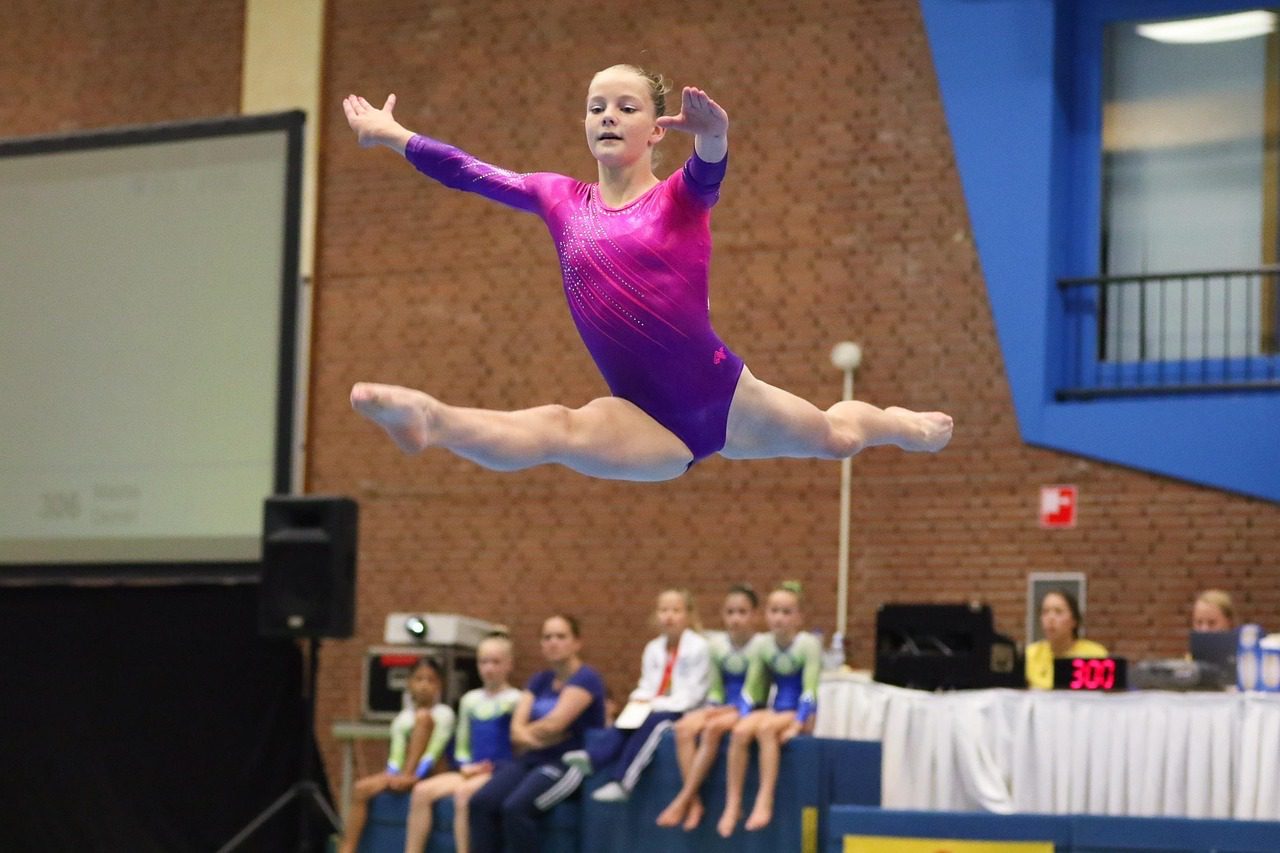
The 1st Great Britain Championships took place at the Albert Hall in 1961, drawing over 6,000 spectators to watch the athletes. This event continued until 1971, eventually transforming into the Champions’ Cup, which was also held at the Albert Hall until 1974. Membership in gymnastics clubs soared in London, growing from 1,500 people in 1967 to 8,000 in 1978.
Individual membership for gymnasts was introduced in 1980, requiring all clubs to register members individually. The funding of the BAGA (British Amateur Gymnastic Association) changed, and a national insurance scheme was also put in place.
The 2012 London Olympics marked a pinnacle for the sport, with the North Greenwich Arena providing the stage for a men’s team bronze, and Louis Smith and Max Whitlock securing silver and bronze respectively. Beth Tweddle also clinched a bronze on the uneven bars. At this time, British gymnasts were incredibly popular.
Modern Development
The 20th century saw a rapid increase in the number of clubs and associations, with British Gymnastics officially becoming the governing body. Notably, in 1997, British Gymnastics won the right to host one of the most prestigious rhythmic gymnastics competitions, initially called the “Grand Prix,” which is now the “World Cup.” New centres, such as the Queen Elizabeth Olympic Park, began to emerge, with a strong focus on inclusivity.

Today, London’s clubs offer a wide array of gymnastics, from rhythmic to acrobatic. Young Londoners can start gymnastics from as early as five years old, whether for fun or to progress according to their abilities. The city’s most popular clubs include Anna’s Gymnastics Academy, City of London Gymnastics Club, Mayfield Gymnastics Club, and Wimbledon Gymnastics and Dance Centre, where artistic gymnastics is often blended with dance, coaching, and competition.
Naturally, the development of gymnastics in London has faced both challenges and opportunities throughout its history. Clubs frequently have to rent facilities, which can sometimes restrict training. There is also a persistent shortage of qualified coaches and funding. Nevertheless, safety standards are improving year on year, and programmes for different age groups are expanding. Modern gymnastics has become accessible, diverse, and full of potential.
Ultimately, London gymnastics has travelled a long road of growth, enduring wars and crises. London stands every chance of remaining one of the world’s leading cities where the sport continues to rapidly evolve.
Used sources: