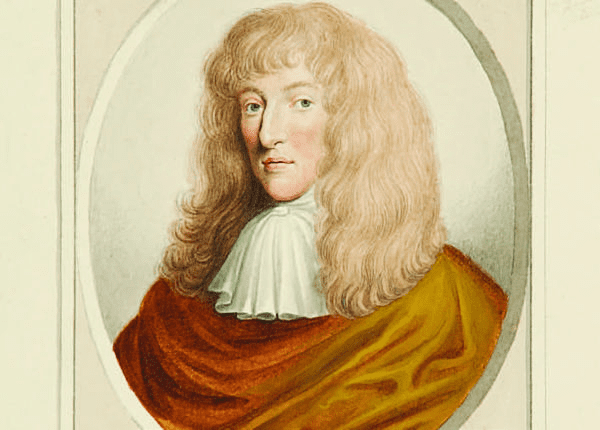

London is a city known for its talented residents. An honourable place is occupied by scientists who tried to improve life in the whole of Great Britain at different times. Most of these people have devoted their entire lives to studying and researching numerous scientific fields. Christopher Merret was one of them. He researched a huge variety of topics. In particular, Christopher Merret became famous for being the first to document the deliberate addition of sugar to produce sparkling wine. The scientist also compiled the first lists of birds and butterflies of Great Britain. What other fields was he interested in and why is his contribution to science so significant? Learn more at ilondon.
The first steps in scientific activity
Christopher Merret was born not in London but in the small market town of Winchcombe. However, the scientist lived most of his life and realised himself as a scientist in the capital of Great Britain. Before Christopher moved to this city, he entered Gloucester Hall. Then he continued to study at Oxford and received his BA from Oriel College in 1635. Christopher Merret seemed to have found his vocation in science. The very next year, he received a BMed degree. 1643 can be considered the final educational year in his life, as in that year, Christopher received his DMed degree at Gloucester Hall. Subsequently, he began to practise medicine in London and became a member of the Royal College of Physicians in 1651. After about three years, he eventually moved to the city, got a room and worked as a librarian.
A variety of researched fields
In the early 1660s, Christopher Merret immersed himself in the research of metallurgy. He was particularly interested in the industrial use of minerals. A little later, while researching glass-making technologies, the scientist turned his attention to wine production. It seems that these are quite different spheres, but they have a lot in common. First of all, the drink is poured out into bottles. So, they must be of the highest quality due to wine fermentation processes. Thus, Christopher Merret spent many years studying this very issue. Later, he developed an interest in botany and compiled one of the first lists of British flora, fauna and minerals.
Publications that entered the history of science
Being interested in glassmaking and metallurgy, Christopher Merret devoted much attention to writing various scientific works on this topic. In particular, in 1662, he translated the well-known book of the Italian Antonio Neri L’Arte Vetraria, which vividly depicts the methods of manufacturing and painting glass, enamels and pastes, as well as provides a lot of interesting information dedicated to this field. In general, this work is considered the first general treatise on the systematics of glass making. Christopher Merret not only translated it from Italian but also added 147 pages of his own reflections and observations. In addition, he wrote a large number of articles on tin mining and smelting. In December 1662, the scientist wrote another scientific work Some Observations concerning the Ordering of Wines. There, he described the process of adding certain amounts of sugar and molasses to make the wine heady and sparkling. The article was presented at the general meeting of the Royal Society.
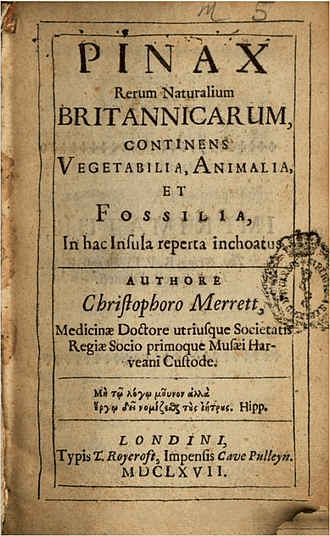
Photo source: Wikipedia
One of the most famous scientist’s works is Pinax Rerum Naturalium Britannicarum. Christopher Merret wrote it when he was engaged in scientific activities as a naturalist. This work was published in 1666 and resembled an alphabetical catalogue without additional explanatory comments. Nevertheless, it contains the first lists of British birds and butterflies and that is why it’s so unique and valuable.