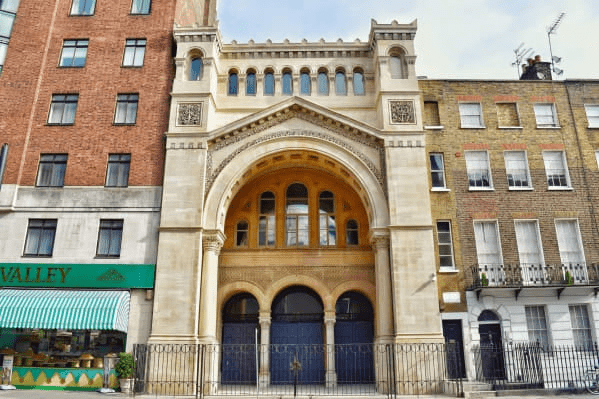

There are many religious places in London. Usually, they are filled with a special atmosphere. In churches, temples and cathedrals, the world feels somewhat different. There, you can often meet a couple of beautiful newlyweds, come across the baptism of a baby or attend the first communion of young girls and boys. People also come to such places just to think about their lives and be alone with themselves. One of these amazing locations is the West London Synagogue. For years, people came here to pray to God. Nowadays, this place reflects beautiful architecture and its interesting history. Learn more at ilondon.
Prerequisites for synagogue emergence in London
The main prerequisite for the establishment of synagogues throughout England was the appearance of Jews in the country. They settled in small groups in different parts of Great Britain and London in particular. Representatives of this nation played a rather important role in the development of the economy. However, the authorities weren’t always sympathetic to them, which was reflected in their religion. For example, in the 18th century, there was a mass closure of synagogues and Jews had to practise their religion in secret. Therefore, nowadays, a synagogue is much more than just a building where you can pray. Such places reflect the entire history of the Jewish people.
History that began in the 19th century
The West London Synagogue was founded on April 15, 1840. This happened thanks to representatives of influential Jewish families who founded the British movement for the reform of Judaism. They also abolished some established customs and removed various prayers based on rabbinic tradition. The fact that the synagogue wasn’t always located in a building that is known to everyone nowadays is also interesting. The synagogue was consecrated for the first time in another, smaller building in 1842. Later, it turned out that it wasn’t spacious enough for gatherings. On September 22, 1870, the current building of the synagogue was consecrated. This gives it the right to be called one of the oldest synagogues in the whole of Great Britain.
Throughout its history, the West London Synagogue has experienced many changes and events. For example, one of the most interesting was the decision to allow men and women to be in the synagogue during religious services together. It was adopted in the 1920s. Also, many aspects that entered the history of the institution were connected with the appointment of a new rabbi. The replacement of this person has always been one of the most important events for the Jews. The selection of the candidate was a key moment in that process.
Neo-Byzantine style and features of building planning
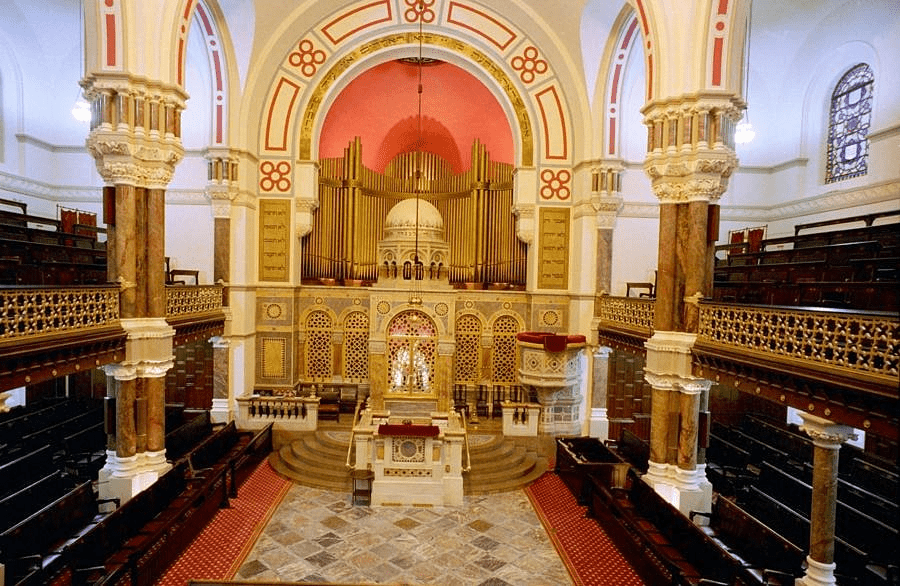
The West London Synagogue is a listed building, which means it is included in the list of monuments of the architectural heritage of Great Britain. It is also the oldest synagogue in the country, closely associated with Reform Judaism. Thus, its architecture attracts the attention of tourists and researchers from different parts of the world. The facility was built by the Davis & Emmanuel company. The synagogue is a vivid example of the Neo-Byzantine style, which is characterised by rounded shapes, spacious halls and other interesting elements. The West London Synagogue has two eye-catching columns on the sides supporting a window arcade. Above, you can see a lot of other, smaller elements. Unlike other temples of that period in London, the interior of the building is quite spacious. The hall isn’t divided by a cross vault. Thus, it seems large and can accommodate many people. The services are accompanied by an organ located at the back of the bema. There is another landmark near the synagogue, the Marble Arch.