In the late 20th century, there arose an urgent need to optimise staff communication within the professional information sphere. The responsibility for addressing this was ultimately taken on by Timothy Berners-Lee—an English scientist and computer expert. Read more at ilondon.info.
Tim Berners-Lee’s Early Years and Inventive Career
Timothy Berners-Lee was born on 8 June 1955, in London. Both his parents, Mary Lee Woods and Conway Berners-Lee, originally from Birmingham, were computer scientists. They worked together on the team that developed programs for the Ferranti Mark 1, the world’s first commercial computer. Growing up with three younger siblings, their eldest son enrolled at the direct grant grammar school, Emanuel School, in 1963. He then began his studies at Queen’s College, Oxford, in 1973.
After earning a first-class Bachelor of Arts degree in Physics, Tim Berners-Lee took a position as an engineer at the telecommunications company Plessey. In 1978, his professional experience allowed him to join DG Nash in developing software. In 1980, the specialist became an independent contractor at CERN. During his time in Switzerland, he proposed a hypertext project to facilitate information sharing among scientists. Following this, the researcher wrote a software prototype for the system, naming it INQUIRE.
In 1981, Tim Berners-Lee became the technical lead for Image Computer Systems Ltd. His focus at the time was on working on a real-time remote procedure call project. The specialist eventually returned to CERN as a research fellow in 1984. Working at Europe’s largest Internet node inspired him to combine hypertext with the digital network. Initially, the World Wide Web project was aimed at optimising human collaboration. The first server and client became available to CERN in 1990 and to the wider public in 1991. The invention of the World Wide Web was ranked first in a list of the 80 most important cultural moments for its revolutionary contribution to human communication.
In 1990, Tim Berners-Lee married American programmer Nancy Carlson, with whom he raised two children. Four years later, he founded the World Wide Web Consortium (W3C) at the Massachusetts Institute of Technology (MIT). Based on open, royalty-free standards, the W3C admitted companies wishing to participate in improving the quality of the Internet. In 2001, the inventor became the patron of the East Dorset Heritage Trust, an educational charity.
In 2004, Tim Berners-Lee was invited to the Chair of Computer Science at the School of Electronics and Computer Science at the University of Southampton, where he worked on creating the Semantic Web. In 2009, he established the World Wide Web Foundation, which aimed to popularise the extensive opportunities offered by the Internet. The following year, the inventor collaborated on the development of the UK government’s data project, data.gov.uk. After divorcing his first wife, he married Canadian entrepreneur Rosemary Leith in 2014. Four years later, based on his Internet decentralisation project, Solid, Tim Berners-Lee presented a new startup, Inrupt, dedicated to securing the integrity of the new network.
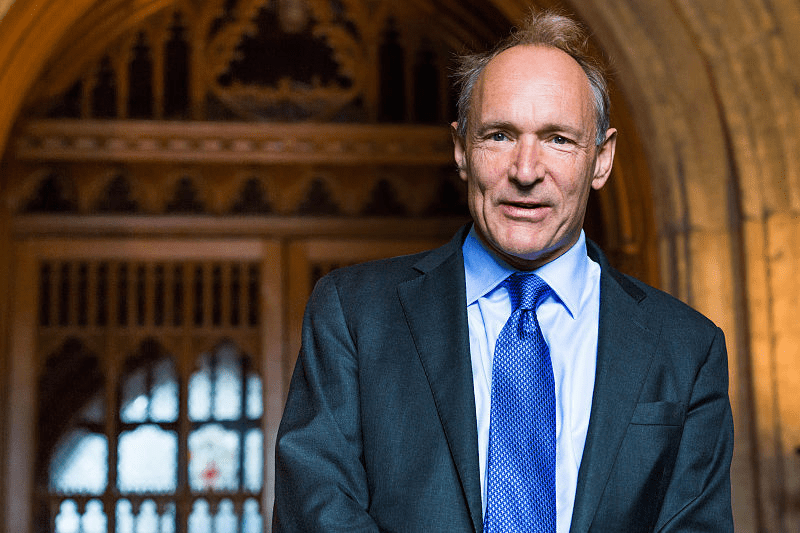
Wikipedia
Recognition and Significance of Tim Berners-Lee’s Work
Tim Berners-Lee will forever be remembered as a revolutionary in remote communication. As the founder of the global network, he has also been responsible for initiatives such as the World Wide Web Consortium, the Web Science Trust, the World Wide Web Foundation, and more. For his work, the inventor has been honoured with the Order of Merit, the Queen Elizabeth Prize for Engineering, the Turing Award from the Association for Computing Machinery, and numerous other accolades.
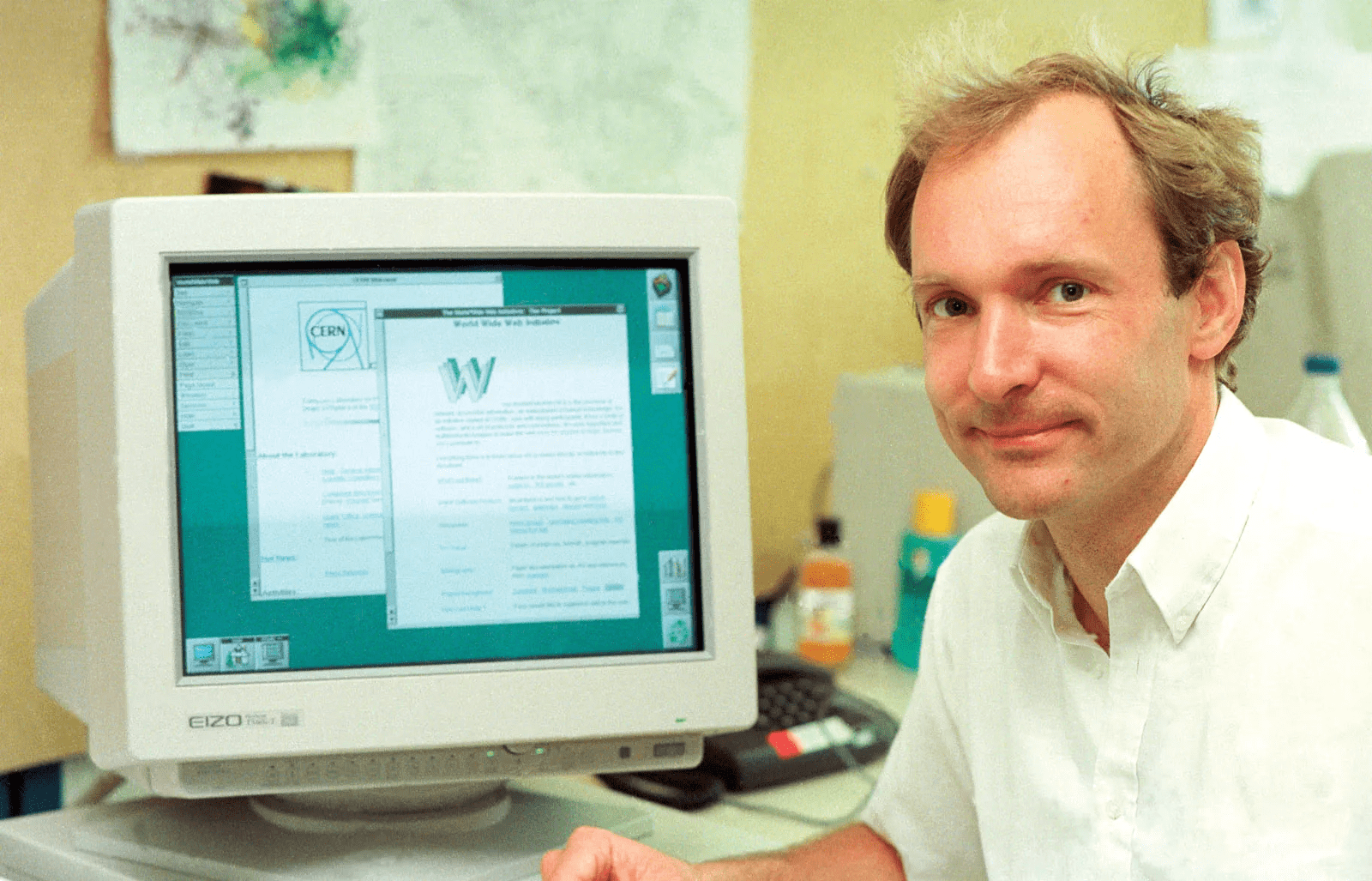
Britannica