

Every city in the world has its own unique character, smells, tastes, style and history. The history of London contains a large number of significant events, such as world-known discoveries, terrible epidemics of the Middle Ages, the construction of amazing architectural objects, famous festivals and much more. The city’s coat of arms is a reflection of the past and the present. It is a symbol and hallmark of London, as it reveals its entire essence. If you find out the meaning of encrypted symbols and translate the inscriptions, you can learn new information about this city. Learn more at ilondon.info.
The history dating back to the 1300s
The exact date of the coat of arms’ creation is unknown, but in 1381, the image was already used at the mayoral seal. Prior to that, the seal most likely depicted St. Paul with a sword. The found artefacts, which date back to the 13th century, depicted a shield on the seal. A similar shield appeared in 1381. Throughout its existence, the design has undergone changes and additions several times. In particular, the original image shows two mirroring lions flanking the shield, but in 1609, they were replaced by two silver dragons with wings. Until the middle of the 19th century, a Muscovy hat crowned the composition from above, but later, it was removed. This design has been used as a coat of arms since the 17th century, albeit unofficially. On April 30, 1957, the coat of arms acquired official status, as it was confirmed by letters patent.
Interesting symbols and their meanings
Interesting historical objects always attract the attention of researchers and scientists. This is what happened with the coat of arms of the City of London. This symbol of the city has become an object of controversy and debate. There are several interesting theories regarding the symbolism of the coat of arms elements. In particular, the debate revolved around the red sword on the shield. For a long time, there was an opinion that it was a sword, with which the then Lord Mayor of London killed Wat Tyler (a man who organised the Peasants’ Revolt in England in 1381). However, the theory has been refuted because the coat of arms was created several months before that event and the sword couldn’t be a symbol of murder in this context.
A more acceptable interpretation of the symbolism of the main coat of arms element is a combination of the emblems of the patrons of England and London. The shield with the red cross and sword represents the martyrdom of St. Paul and the power of St. George. Some believe that the latter’s homeland is England. This version is the most widespread and is based on a thorough explanation.
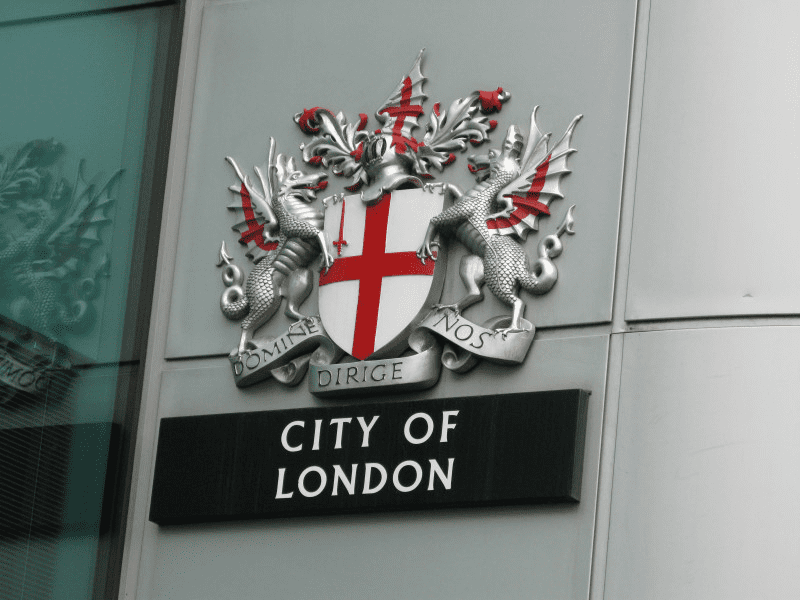
The general composition of the elements of the coat of arms includes a knight’s helmet, a shield, two dragons on the sides and an inscription in Latin below. Silver and red colours give the emblem a special style and also contain deep meaning. On the top, there is a knight’s helmet with a closed golden visor, which is crowned with a dragon’s wing. The helmet was added relatively recently (in the middle of the 19th century) when the design underwent certain changes. In the middle of the emblem, there is a shield divided into four parts by a red cross. At the top left quarter, there is a sword that resembles the flag of London. Two mythical dragons flank the crest on the sides. According to legends, they are a symbol of St George the Dragon Slayer. This element also features a perfect combination of colours. Red dragons’ tongues and crosses on their wings stand out against a silver background. From below, the composition is complemented by a silver ribbon with the Latin inscription “Domine dirige nos”, which translates as “God leads us”.