
London is a tourist city because it can boast of many interesting places. But what really makes all these locations so special and popular? Their histories play an important role for sure. Quite often, famous buildings, monuments and other similar spots hide mysterious secrets and events behind thick walls. A lot of people seek to learn their deep meaning. Therefore, one of the most popular places in London is the Royal Artillery Memorial. The monument is not only an example of amazing architecture but also tells an interesting story. Learn more at ilondon.
History of creation
The impetus for the creation of such a historical object was the First World War. The monument is not only a reminder of the extremely important role of the artillery at the time but, above all, it commemorates the 49,076 soldiers of the Royal Artillery who died in the course of those terrible events. The London authorities and leading architects understood that they should find a special approach to such a serious topic. It would be inappropriate to depict chunky cheerful soldiers on the monument because, at that time, people had repeatedly faced the horrors of war and seen with their own eyes its consequences. While the hospitals were filled with the wounded, whose faces and bodies were covered with scars, people hardly wanted to see idealised images on the streets of the city. Therefore, the memorial was designed by Charles Jagger. The sculptor was not only an architect but also served in the military himself, took an active part in the war and was even wounded. Thus, he was meant to implement such a deep plan. This incredible memorial was opened in 1925.
Architectural peculiarities and symbolism
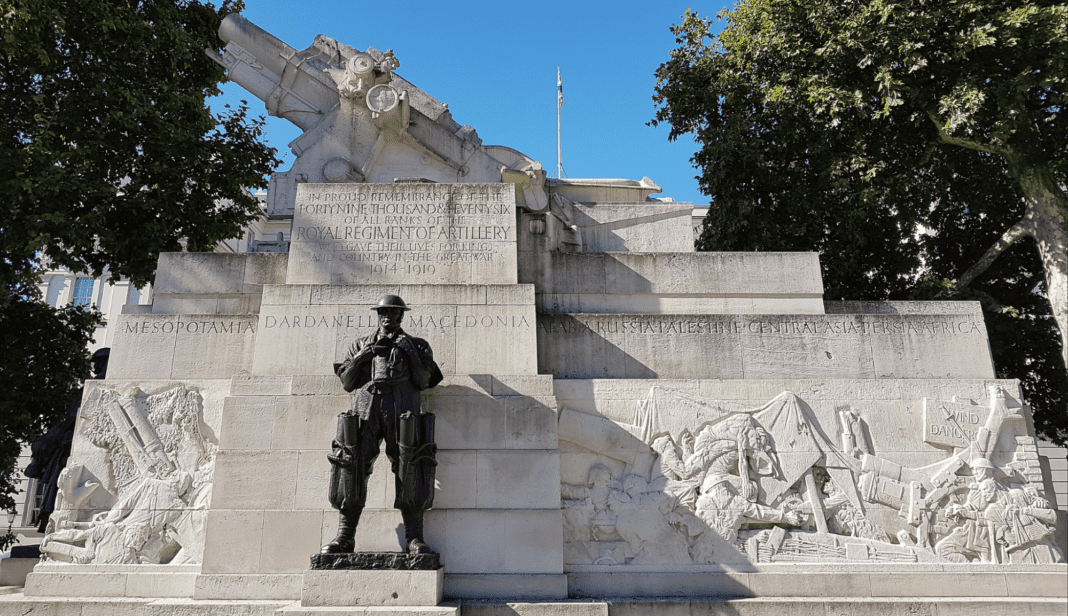
The Royal Artillery Memorial is impressive. It combines different materials and creative ideas. The main element of the entire exposition is the howitzer, which was created according to the original model located in the Imperial Military Museum. The howitzer and the pedestal beneath were made of Portland stone. Bronze statues of soldiers can be seen from different sides of the memorial. In the middle, facing south, stands the commander, holding his overcoat in his hands. From the eastern side, you can see a soldier feeding shells. On the west side of the memorial, there is a statue of the driver. The fourth statue is the most tragic, a dead soldier covered with a helmet and an overcoat. It makes clear that small details play the most important role in the emotional perception of the object. Such elements are present from different sides of the monument. They depict the horrific scenes of the First World War. The inscriptions hide the centuries-old tragic meanings, which were once meant by Shakespeare.
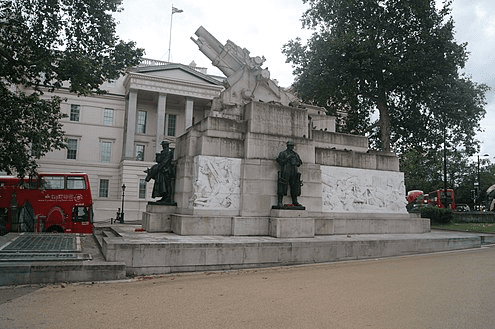
This memorial significantly differs from other similar monuments because it doesn’t aim to idealise the military and the war itself. Unlike earlier English works of art devoted to the First World War, which depicted brave characters and heroic deaths. The Royal Artillery Memorial reflects a more realistic world, in which both soldiers and society lived for years. The architect tried to create sculptures that would reproduce the power of ordinary soldiers but as close as possible to their real emotional and psychological state. Some elements of bronze statues indicate hard physical labour. When you look at these figures, you see deep thoughts and exhaustion in their faces.